Overview
What it is
The Fashion Trend Dashboard is my dissertation artefact — an AI system that classifies fashion images by style, colour, and pattern using a trained machine learning model. Users upload one or more garment images and the tool returns a classification with confidence scores, a trend summary, and a style distribution breakdown.
Unlike the Micro AI Trend Forecaster which works with sales data, this tool works with images directly — making it closer to how a human trend analyst would work, looking at garments rather than spreadsheets.
76%
Model accuracy
Style classification across romantic, casual, formal categories
3x
Classification outputs
Colour · Pattern · Style — each with confidence score
99%
Pattern accuracy
Highest performing classifier in the model
The Product
Classification interface
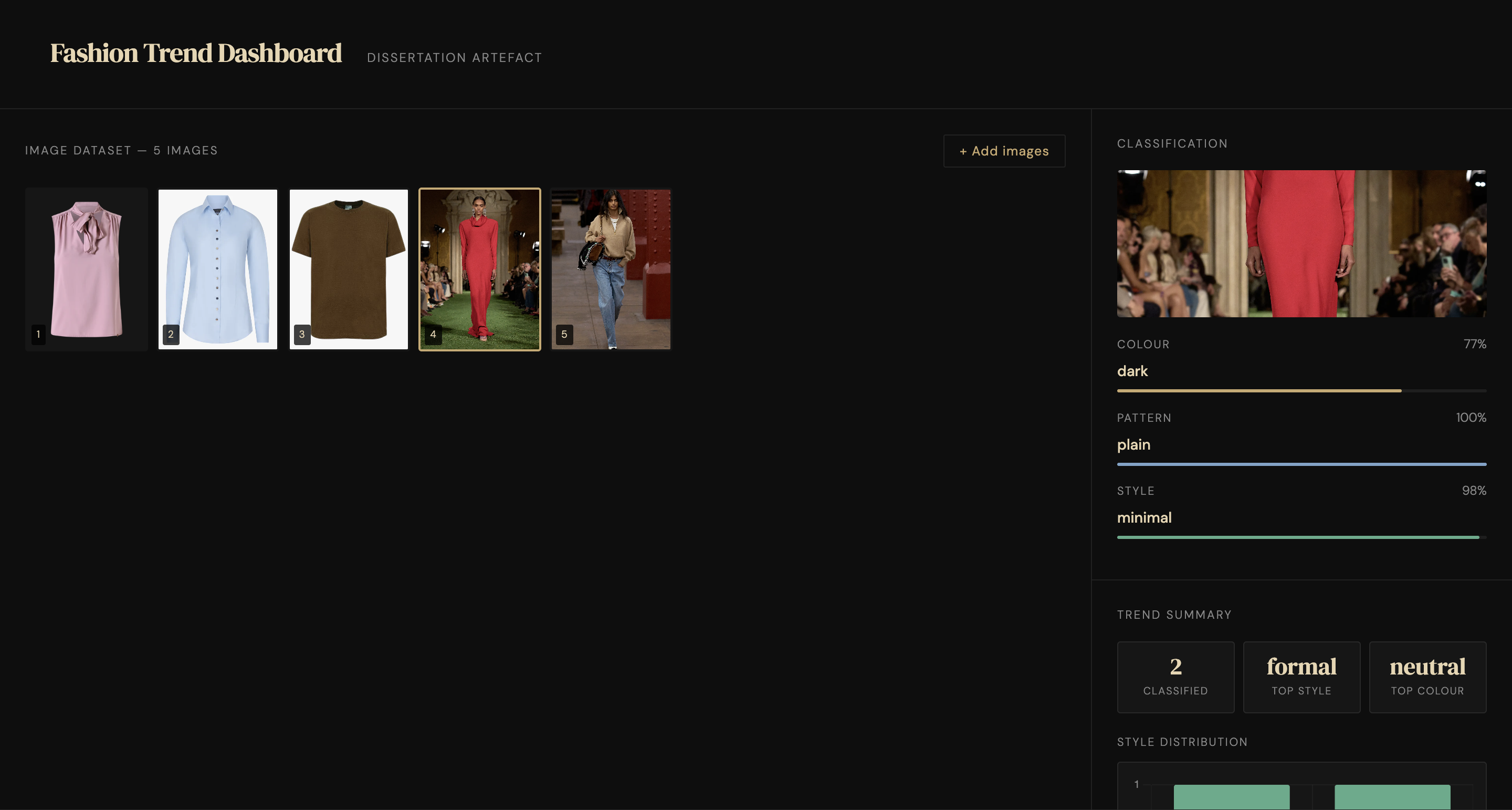
Classification results showing colour (56%), pattern (99%), and style (76%) confidence scores for a uploaded garment image
Process
Key decisions
01
Three separate classifiers instead of one model
I trained separate models for colour, pattern, and style rather than one multi-output model. This gave me better control over each classifier's accuracy and made it easier to debug when one was performing poorly — pattern accuracy hit 99% while colour was harder at 56%, which a single model would have obscured.
02
Showing confidence scores, not just labels
Showing the percentage alongside each classification was a deliberate design decision. It makes the AI feel honest — a 56% colour confidence communicates uncertainty in a way that just saying "neutral" doesn't. Users can make better decisions with that context.
03
Dark UI for the dashboard
The dark interface was a deliberate contrast to the rest of my portfolio. Fashion classification tools need to show garment colours accurately — a dark background reduces visual interference and lets the image speak. It also felt more like a professional tool than a student project.